
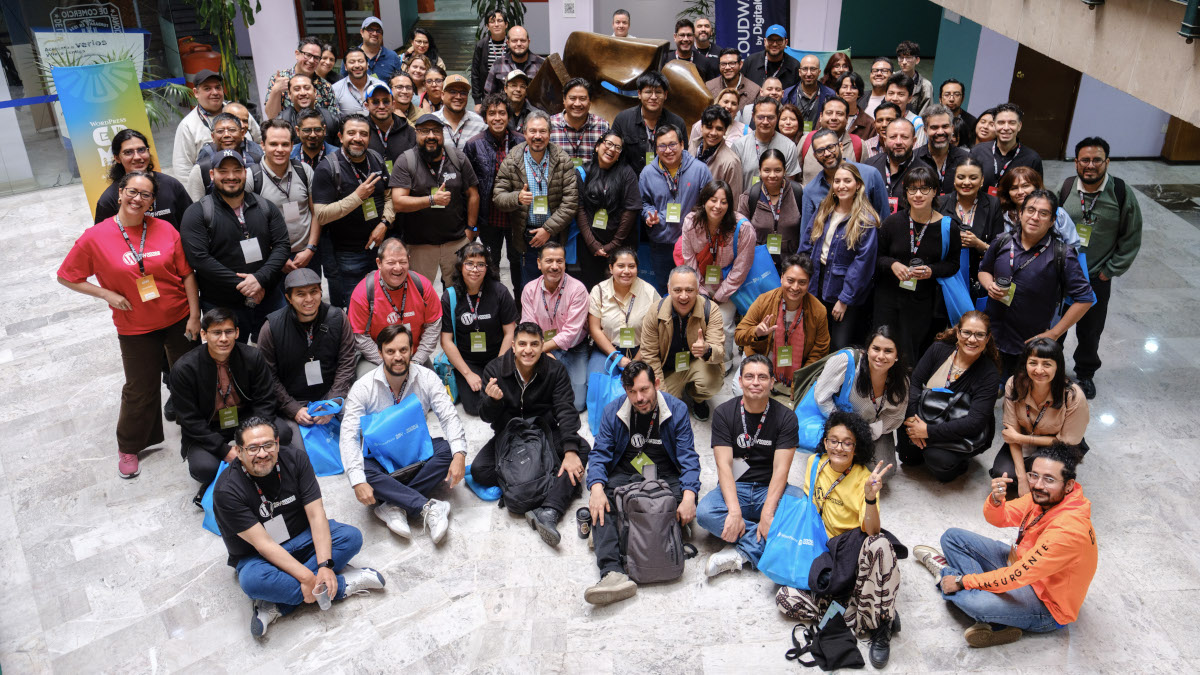
As always, at these kinds of events, I learn a lot! Thanks, DreamHost, for sponsoring my trip!
Be aware that my recap is from the perspective of an organizer and a speaker, so I’m a bit biased and might say everything was perfect.
After the event, I told my friend Victor that I knew it was possible to organize an event this big with a very small team of organizers, and joked that I’d learned that the hard way on other events, when the main leader didn’t exactly let us do our jobs.

A WordPress Day is smaller than a WordCamp but is technically almost the same. For example, a one-day event is much easier and cheaper, and tickets seem to sell faster. I suspect more people find it easier to commit.

At the first talk, a reasonable percentage of attendees showed up, given how big Mexico City is and that some people came from far away.
Lucrecia Ang was the first speaker, which made the start of the day very energetic. She is a total pro—inspiring and articulate.

The lesson I take from her is to open up about my vulnerabilities in front of everyone so others can do the same in private if they want, identify what to improve, and set a goal on paper to make it real to stick to. Who do you want to become, and what do you need? In my case, I want to keep helping people realize that there can be fun in what they do and to break the rules a little.
I handled the technical side of the talks, making sure everything was OK with the speakers, preparing their slides, and handing them the clicker and microphone. That comes with a big reward: you get to see all the talks!
Mariana Salas reminded us in the second talk that building or selling a website, at least a commercial one, is not worth it if no one visits it.

The lesson I take from her is that we can start campaigns with very little money and still measure their impact reliably. If you spend less, you just have to wait longer to get results, but it’s always better to bring in targeted visitors.
Jer had a very challenging time taking pictures because the lighting was poor and the wall color wasn’t helping. The contrast with the screen was also difficult to improve because if we turned the lights down, the faces didn’t show up properly. On the other hand, the screen was big, so the presentation worked well even from far away, as long as the font size was large enough.

At first, I wasn’t sure whether Francisco Chávez‘s next talk on eCommerce would contribute meaningfully to an event focused on AI, but to my surprise, it was one of the most interesting sessions.

Similar to Mariana’s talk about MKT, the years of experience in a specialty were a gift to attendees, prompting them to consider a more professional approach to doing business that covers several steps, not just coding.
I envy Francisco’s deep voice and confidence. He tells jokes and engages deeply with his developer audience. The lesson I take from him is to analyze the business development I’ve done over the years more thoroughly to drive immediate impact.
Then it was my turn to talk! For some reason, I wasn’t nervous; maybe it was because I was a bit tired from organizing. My talk was about how to ask AI to build a plugin that builds plugins. A total nightmare for seasoned developers.

I think that with mine, AI talks formally started this day, but not so much the formal ones; I focused on having fun with prompts and on reminding people they can build whatever they want, including video games.
If AI is just copying it- and, by the way, it is very good at doing it with the right prompts and patterns- why not take advantage of that to make cool demos? Using tools like staging, you could install your own plugin to build plugins and develop ideas to show them or sell them more easily.
And you don’t even have to spend so many tokens if you use the REST API.

My main lesson was to make my talks even more interactive. Showing the actual game and its features was cool, but I love getting people involved and asking them questions.
As always, things happen, and for some reason, even though we tested it, the sound didn’t work. It didn’t occur to me that I could have just placed the mic near the laptop’s speaker.
I missed the opportunity to have them play the game and provide feedback on it. One cool idea I had was to convert those suggestions into AI prompts with a simple “apply” button.
I loved seeing their reactions and pointing out things like, “You are laughing because it has happened to you,” or “You are totally going to apply this.” I think I lean more toward stand-up comedy with an educational flavor.
I installed the latest version of the plugin I generated with my plugin so you can play around:
Then it was Hugo Díaz‘s turn, who talked about how everyone can easily create a website with AI now, but making a good one is another story.

Similar to the previous speakers, except for me, Hugo focused on the importance of doing things in very formal stages like planning, creating the web layout by the use of patterns, and migrating.
Getting to know the builder you use deeply will let you feed your AI the right knowledge to train it on good patterns repeatedly, making it a monster at building websites, as he says.
It resembles what I’ve been doing with my plugin, even though mine is mainly for fun or testing. So maybe mine is step 0, and his is the proper way to do things after that.

Finally, in the last talk, Petter Briones showed us, with passion, how to create more effective campaigns and compare them using AI.
The same concept of creating several ads and pitting them against each other, using obvious but usually unapplied simple strategies, like recording the same video with several actors to see which one performs better.
For most of the audience at this event, who focused more on web development, this reveals a world of possibilities.
In the end, the difference in results between a campaign run entirely by AI and a human-run one will be minimal if the AI is used properly and with experience.

Petter knows well how to convince the audience and is an example of someone who knows when to mentor a customer who is just starting or sell his services when that customer is actively running campaigns to optimize.
In general, the message of all the talks was to use AI to speed up the process while relying on and trusting human experience.
Overall, people were happy and wanted even more talks! There’s definitely room to grow the WordPress Day event in Mexico City before turning it into a WordCamp again. Or maybe it can have both.
Thanks, Julio, Dario, Jer, Kat, and all the volunteers!

For the rest of the photos, visit https://adobe.ly/3So2lct.
Leave a Reply